SpaceX shows first look at million-satellite 'Starmind' AI constellation that Musk calls a step toward Kardashev Type II
SpaceX released its first video of Starmind, a proposed constellation of up to one million solar-powered orbital data centers. Elon Musk has described the plan, tied to SpaceX's acquisition of Grok maker xAI, as a first step toward a Kardashev Type II civilization.
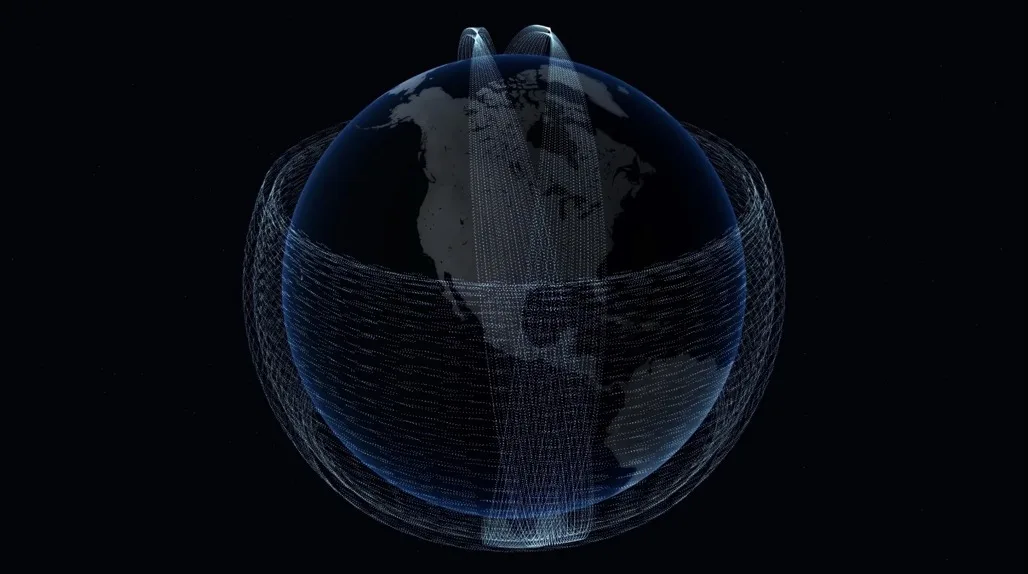
Credit: SpaceX
Watch SpaceX's video on starlink.com →
SpaceX has released its first official video of Starmind, a proposed constellation of up to one million satellites designed to operate as data centers in orbit, PCMag reported on October 6. The video, from Starlink's business arm, shows the satellites forming rings around Earth. According to PCMag, the system would be about 100 times larger than the current Starlink network, and the Federal Communications Commission is still reviewing SpaceX's application.
Speaking at the International Astronautical Congress in Türkiye, SpaceX senior vice president Michael Nicolls said the video only shows what Starmind "might look like," calling it "a very notional concept" that is "probably wrong, and will change a lot," PCMag reported. Nicolls said SpaceX plans to launch the first Starmind satellites next year and that the company believes Starmind "will be the largest consumer of orbital capacity for Starship."
According to PCMag, about half of the satellites would fly in sun-synchronous orbits to stay in sunlight as long as possible. SpaceX told the FCC in January that those satellites are "ideal for energy-intensive AI workloads." Each satellite could have a mass of up to 4,000 kg and a solar array spanning up to 246 feet, and SpaceX expects them to operate for about five years before being retired to "graveyard" orbits around the Sun.
Where the Kardashev scale comes in
The Starmind plan is linked to SpaceX's acquisition of xAI, the company behind the Grok chatbot, which SpaceX announced in early February. In the announcement, published by CNBC-TV18, Musk wrote that "launching a constellation of a million satellites that operate as orbital data centers is a first step towards becoming a Kardashev II-level civilization, one that can harness the Sun's full power." He also wrote that lunar factories and an electromagnetic mass driver could eventually put "500 to 1000 TW/year of AI satellites into deep space." The combined company's AI unit, now called SpaceXAI, continues to ship Grok products, including an enterprise iOS app released on October 1, according to 9to5Mac.
CNN reported in July that Musk has referenced the Kardashev scale often, including in a video SpaceX shared on X ahead of its initial public offering in June, where he said, "Any self-respecting civilization should at least reach Kardashev Type II."
What the scale measures
Soviet astronomer Nikolai Kardashev proposed the scale in a 1964 paper, "Transmission of Information by Extraterrestrial Civilizations," published in English in Soviet Astronomy. It classifies civilizations by the energy they can harness: Type I uses the energy available on its home planet, Type II the full output of its star, and Type III the energy of an entire galaxy. Kardashev described Type I as close to the technological level Earth had reached at the time, CNN noted.
In the 1970s, astronomer Carl Sagan made the scale continuous with the formula K = (log10 P − 6) / 10, where P is power in watts. On that formula, Type I corresponds to 10^16 watts, Type II to 10^26 watts and Type III to 10^36 watts, as described in a 2023 study in Scientific Reports. Sagan estimated humanity at about Type 0.7.
Where humanity stands
The 2023 Scientific Reports study by researchers at Caltech and Sorbonne Université put humanity at Type 0.7276 and projected Type 0.7449 by 2060. Its authors concluded that on current energy trends, reaching Type I could take millennia.
Newer data gives a similar result. The Energy Institute's 2026 Statistical Review, released with Ember, reported that total global energy supply exceeded 600 exajoules in 2025. Spread over a year (about 31.6 million seconds), 600 exajoules equals an average of roughly 1.9 × 10^13 watts, or 19 terawatts. Plugging that into Sagan's formula gives K ≈ (13.28 − 6) / 10 ≈ 0.73. Reaching the 10^16-watt Type I level would require roughly 500 times today's average power use.
Experts raise concerns
Penn State astronomer Jason Wright told CNN that a million-satellite constellation is technically a step toward Type II, but that harnessing all of the Sun's power would require more material than exists in the asteroid belt. "This is not a realistic or desirable goal for humanity to be pursuing," he said. Antong Zhang, lead author of the 2023 study, told CNN that such a project would amount to "a first attempt at using space-based solar energy harvesting."
Starmind has also drawn concern from astronomers over light pollution, PCMag reported. University of Regina astronomer Samantha Lawler, who co-authored a paper on light pollution from orbiting data centers, said SpaceX's map "looks pretty much just like the simulations we made, which is not a good thing!"
Sources (7)
- PCMag — Bigger Than Starlink: SpaceX Provides New Look at Orbital Data Center Plans (Oct 6, 2026)
- CNBC-TV18 — Here's what Elon Musk wrote to his employees on SpaceX acquiring xAI (Feb 2026)
- CNN — Elon Musk's plans refer to an idea conceived in the 1960s. What is the Kardashev scale? (Jul 10, 2026)
- Kardashev, N. S. (1964). Transmission of Information by Extraterrestrial Civilizations. Soviet Astronomy 8, 217 (NASA ADS)
- Zhang et al. (2023). Forecasting the progression of human civilization on the Kardashev Scale through 2060. Scientific Reports
- Ember — Energy Institute Statistical Review of World Energy 2026
- 9to5Mac — SpaceXAI releases a separate Grok iOS app for enterprise users (Oct 1, 2026)